Gas
Gas is Ethereum’s metering system. It prevents infinite computation and helps protect the network from denial-of-service behavior.
Part 0: Reference Gas Price Quote
Section titled “Part 0: Reference Gas Price Quote”# cast should be installed$ cast gas-price --rpc-url https://ethereum-sepolia-rpc.publicnode.com4845187414Part 1: Fee Formula (Execution-Layer Accurate)
Section titled “Part 1: Fee Formula (Execution-Layer Accurate)”Note:
- Affordability check uses
gasLimit * maxFeePerGas. - Final fee charged uses
gasUsed * effectiveGasPrice.
| Gas System Field | What It Represents | Role in the Fee System |
|---|---|---|
| gasLimit | Maximum execution gas the sender authorizes | Prevents unbounded computation and caps gas exposure |
| gasUsed | Actual execution gas consumed by the transaction | Final fee is charged on this value, not gasLimit |
| gasPrice | Legacy flat fee per gas unit | Used by pre-EIP-1559 (type-0) transactions |
| baseFee | Network-set base gas price per block | Burned under EIP-1559 and adjusts with demand |
| maxPriorityFeePerGas | Sender-set maximum tip per gas for proposer | Incentivizes faster inclusion |
| maxFeePerGas | Sender-set maximum total fee per gas | Caps worst-case effective gas price |
| maxFeePerBlobGas | Sender-set max blob fee per blob gas (type-3) | Caps blob-fee exposure for EIP-4844 transactions |
| blobBaseFee | Protocol-set blob base fee (type-3 market) | Burned for blob data under EIP-4844 |
For type-2 (EIP-1559) transactions, total execution fee paid is:
Practical cap rule:
Where:
baseFeeis protocol-set and burned.effectivePriorityFeeis the validator tip actually paid.- If
baseFee + maxPriorityFeePerGas > maxFeePerGas, the effective priority fee is reduced. - Equivalently:
- If
baseFee > maxFeePerGas, the transaction is not includable in that block.
For type-3 (EIP-4844) transactions, total fee has two components:
With includability constraints:
baseFee <= maxFeePerGasblobBaseFee <= maxFeePerBlobGas
Note: receipt effectiveGasPrice refers to execution gas pricing, not blob-fee pricing.
Example
Section titled “Example”ETH transfer gas used is typically 21,000.
If:
baseFee = 10 gweipriority fee = 2 gwei
Then:
Part 2: Base Fee Adjustment Logic
Section titled “Part 2: Base Fee Adjustment Logic”Sender transactions cannot set baseFee. The protocol computes it deterministically from the parent block.
Variable Ownership and Source of Truth
Section titled “Variable Ownership and Source of Truth”| Variable | What It Means | Who/What Decides It | Notes |
|---|---|---|---|
BaseFee_parent | Base fee in the parent block | Protocol consensus (computed from previous block state) | Not manually chosen by validators; every node derives the same value. |
GasUsed_parent | Total actual execution gas consumed in the parent block | Emerges from real transaction execution in that block | This is the chain-wide actual gas used by included transactions. |
GasLimit_parent | Parent block gas limit ceiling | Validator/proposer proposes updates within protocol bounds; consensus rules enforce validity | Can change gradually, not arbitrarily in one block. |
ElasticityMultiplier | Multiplier that defines target vs max block gas | Protocol constant from EIP-1559 | On Ethereum mainnet this is 2, so target is half of gas limit. |
GasTarget_parent | Target gas level used for base fee adjustment | Deterministically derived by protocol formula | Computed as GasLimit_parent / ElasticityMultiplier, not manually set. |
BaseFee_next | Base fee for the next block | Protocol consensus calculation | Every client computes the same next value using integer arithmetic rules. |
Conceptual update rule:
With:
Important implementation note:
- Clients compute this using integer arithmetic and guardrails (no floating-point in consensus logic).
Implementation Rules (Simplified)
Section titled “Implementation Rules (Simplified)”- If
parent.GasUsed == parentGasTarget, base fee stays unchanged. - If
parent.GasUsed > parentGasTarget, base fee increases (with minimum increment guard). - If
parent.GasUsed < parentGasTarget, base fee decreases (bounded at zero).
Practical Interpretation of 15M / 30M
Section titled “Practical Interpretation of 15M / 30M”When gas limit is around 30,000,000 and elasticity multiplier is 2:
- Target gas is about 15,000,000.
- GasLimit is about 30,000,000.
Standard Scenarios
Section titled “Standard Scenarios”GasUsed = GasTarget: base fee unchanged.GasUsed = 2 * GasTarget: base fee increases by up to about 12.5%.GasUsed = 0: base fee decreases by up to about 12.5%.
Worked Example (100 gwei parent base fee)
Section titled “Worked Example (100 gwei parent base fee)”Assume:
BaseFee_parent = 100 gweiGasTarget_parent = 15,000,000GasUsed_parent = 22,500,000
Then:
Adjustment factor:
Conceptual result:
In execution, clients round by integer-wei math per consensus rules.
Part 3: Transaction Fee Lifecycle
Section titled “Part 3: Transaction Fee Lifecycle”1. Transaction fee process
Section titled “1. Transaction fee process”The 3 gas fields users set in type-2 transactions:
| Field | Description |
|---|---|
gasLimit | Maximum gas units the transaction is allowed to consume. |
maxFeePerGas | Maximum total price per gas unit you are willing to pay. |
maxPriorityFeePerGas | Maximum validator tip per gas unit. |
- You only pay for
gasUsed, not all ofgasLimit. - The execution-layer affordability bound before execution is:
- For type-3 transactions, affordability also includes blob-fee allowance:
- For type-2 transactions, the final charged transaction fee is:
- For type-3 transactions, total charged fee includes execution gas plus blob gas:
- Conceptually, unused allowance can be viewed as:
- Type-3 transactions also have blob-fee headroom:
Refund behavior:
- If
gasLimitis higher thangasUsed, unused gas is not charged. - For EIP-1559 transactions, the difference between your maximum allowance and actual fee is never paid.
Key rules:
- Upfront affordability: the sender must have enough ETH to cover
value + gasLimit * maxFeePerGasbefore execution starts. - Out of gas: if execution exhausts gas, the transaction fails/reverts, but gas spent is still charged.
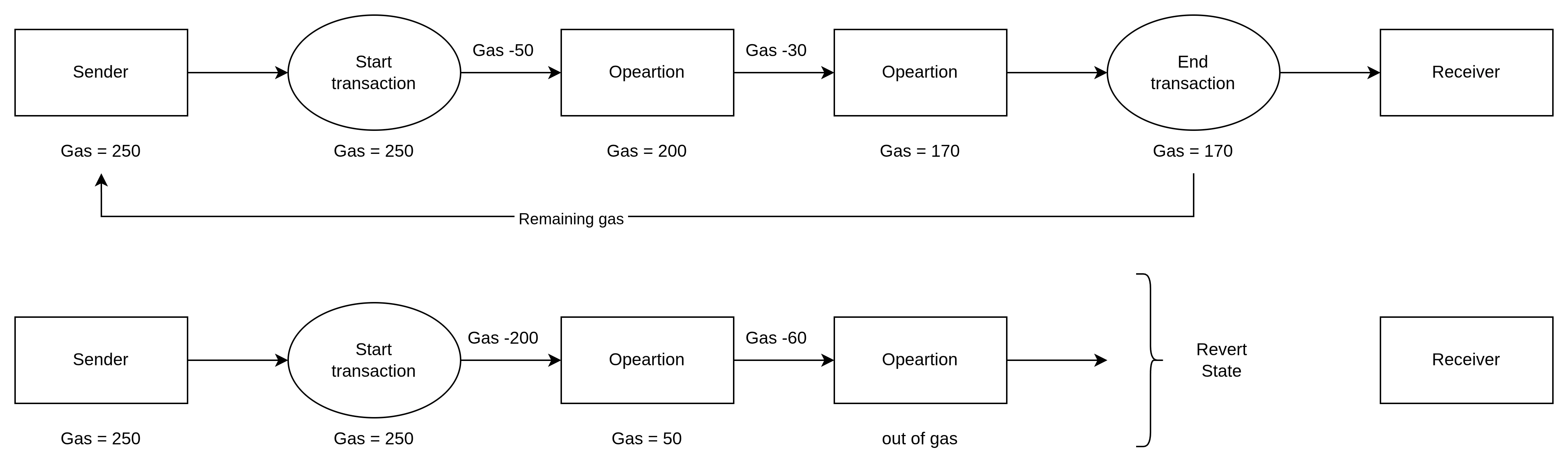
Example for out of gas
Imagine you are trying to execute a complex smart contract interaction, but you set your gas limit too low.
- Gas Required by Contract: units
- Your Gas Limit: units
- Base Fee:
- Priority Fee:
Step 1: The EVM Execution
The EVM starts processing the transaction. It completes the first few operations, consuming gas along the way. Once it hits units, it realizes it needs more to finish but is blocked by your limit.
Step 2: The Revert
The transaction halts. The EVM reads “Out of Gas,” cancels the execution, and reverts the state.
Step 3: The Charge
Even though it failed, the network charges you for the units of work it performed:
- Calculate Effective Gas Price:
- Calculate Total Cost in Gwei:
- Convert to ETH:
You lose , and the transaction fails.
You can use the interactive calculator below to explore how different limits and network fees impact the cost of both successful and Out of Gas transactions.
2. Validator payment
Section titled “2. Validator payment”- Validator/proposer receives priority-fee portion on used gas.
- Under EIP-1559, validator payout excludes base fee.
- Under EIP-4844, blob base fee is also burned (not paid to validator).
3. Base fee burn
Section titled “3. Base fee burn”- Base fee on used gas is removed from supply.
- It is not credited to validator balance.
# EIP-1559 burn accounting (conceptual)burn_amount = gas_used * base_fee_per_gasvalidator_tip = gas_used * effective_priority_fee_per_gas
total_deduction = burn_amount + validator_tip # total fee
sender_balance -= total_deduction # fee charged
total_supply -= burn_amount      # permanently burnedvalidator_balance += validator_tip
# EIP-4844 extension (type-3)blob_burn_amount = blob_gas_used * blob_base_fee_per_gastotal_supply -= blob_burn_amount
Part 4: ETH Supply and Burn Dynamics (EIP-1559)
Section titled “Part 4: ETH Supply and Burn Dynamics (EIP-1559)”Balanced equation
Section titled “Balanced equation”ETH scarcity is a dynamic balance:
New issuance
Section titled “New issuance”- Ethereum issues new ETH to pay validators for consensus security.
- A common recent magnitude is roughly ~2,700 ETH/day, but this is not fixed.
- Issuance scales with validator participation; in simplified terms, aggregate issuance grows sublinearly (approximately with the square root of total ETH staked).
A) New issuance Example, for more detail please go to PoS page
Section titled “A) New issuance Example, for more detail please go to PoS page”Assume:
- Active validators = 600,000
- Effective balance per validator (example assumption) = 32 ETH = 32 * 10^9 gwei
Formula:
Thus,
Burn mechanism
Section titled “Burn mechanism”- For each included transaction, the protocol burns the base-fee portion:
- High activity periods can push burn above issuance (net deflation).
- Lower L1 fee periods, including periods of higher activity on L2 after Dencun blob scaling, can reduce L1 burn below issuance (mild net inflation).
ETH Supply in real-time: ETH supply
Guardrail intuition (economic, not a hard protocol invariant)
Section titled “Guardrail intuition (economic, not a hard protocol invariant)”- ETH is not expected to mechanically burn to zero in practice.
- If ETH becomes very scarce, validator yields and market dynamics can incentivize more staking and dampen fee-burning demand growth.
Reference: 1
Part 5: The Dual-Token Model (Alternative Approach)
Section titled “Part 5: The Dual-Token Model (Alternative Approach)”Some chains use a two-token structure (for example, VeChain VET/VTHO and NEO/“GAS”):
- Primary token: governance, staking, and core network value.
- Secondary token: utility gas token used for fees and often burned.
Reference: 1
Enterprise advantage
Section titled “Enterprise advantage”- Separating the gas token can reduce fee volatility for users and enterprises.
- This can improve operating-cost predictability when gas-token policy is actively managed.
Crypto-economic tradeoff
Section titled “Crypto-economic tradeoff”- Decoupling fee burn from the primary token can weaken direct value-capture feedback to the primary asset.
- In practice, this may reduce alignment between network usage and primary-token scarcity, depending on chain design and governance.