Transaction with Go code
1. End-to-End Pipeline
Section titled “1. End-to-End Pipeline”The following integrated flowchart tracks the lifecycle of a transaction from node ingress to canonical-chain validation, explicitly highlighting how the Consensus Layer directs Geth’s components.
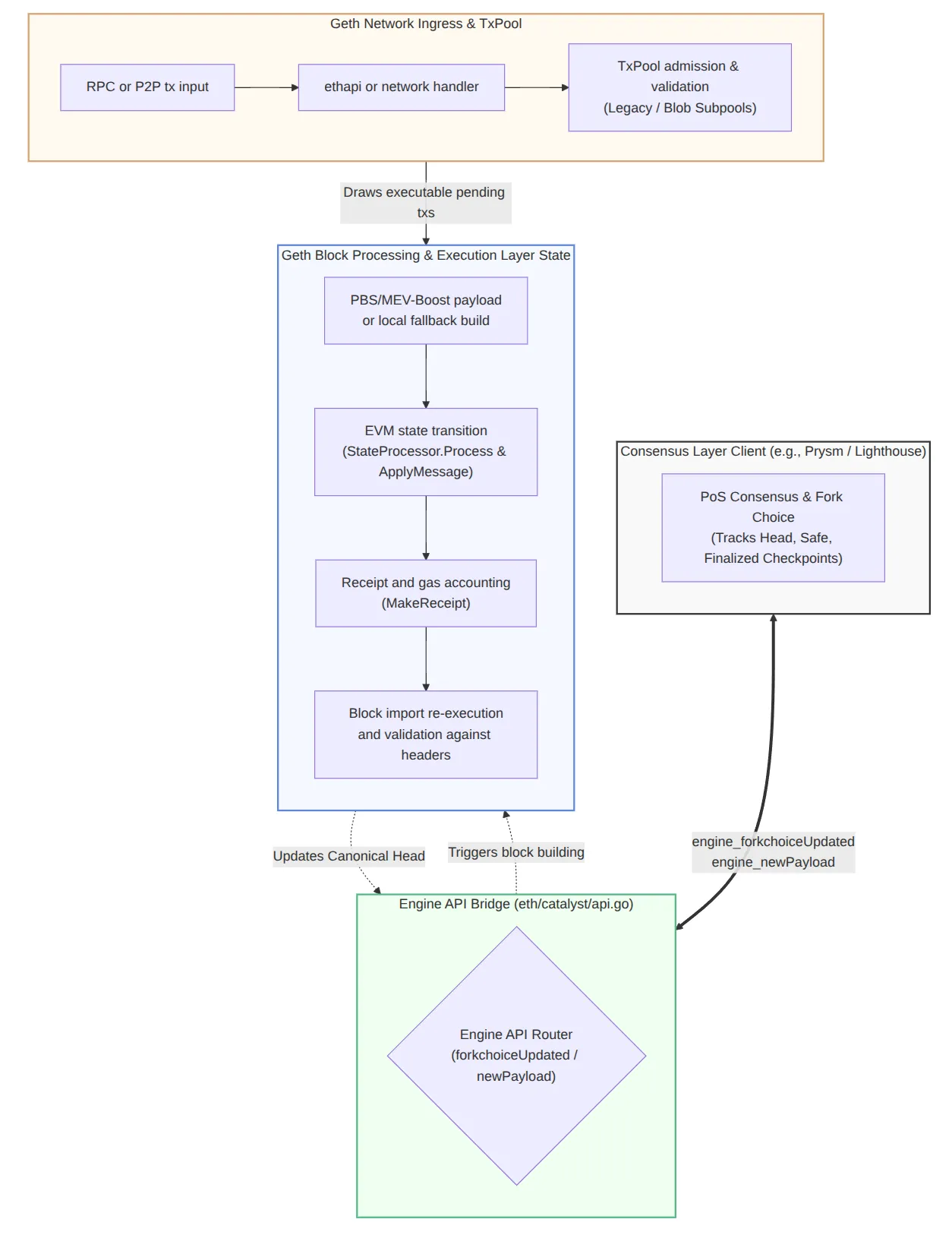
How to read this pipeline:
- Goal: show the transaction’s lifecycle from node ingress to canonical-chain validation.
- Data in: a signed transaction from RPC or p2p.
- Main control path: ingress handler -> txpool -> payload source -> EVM execution -> block import validation.
- Data out: either rejection/queueing in the pool, or a receipt/log set attached to an accepted block.
The important distinction is that txpool acceptance is not final chain acceptance. A transaction can enter the pool, wait as queued/pending data, be skipped by payload selection, and still only become canonical after block execution and import validation succeed.
2. Transaction Submission and Verification
Section titled “2. Transaction Submission and Verification”2.1 Local RPC ingress
Section titled “2.1 Local RPC ingress”- Goal: turn user input into a signed
types.Transactionand hand it to the pool. - Data in: JSON-RPC transaction arguments or raw signed transaction bytes.
- Control path: RPC API validates/fills fields, constructs/decodes the transaction, then submits it through the backend.
- Data out: transaction hash on successful submission, or an error before/inside pool insertion.
For signed-by-node submission:
- Entry is
TransactionAPI.SendTransactionininternal/ethapi/api.go:1674. - It fills defaults (
nonce,gas, fee fields, chain ID), builds a typed transaction, signs it via wallet, and submits it. - Operational note: many public RPC providers disable
eth_sendTransactionbecause they do not manage user private keys server-side.
For pre-signed raw submission:
- Entry is
TransactionAPI.SendRawTransactionininternal/ethapi/api.go:1738. - It decodes raw bytes into
types.Transactionand submits it.
Both paths converge through:
SubmitTransactionininternal/ethapi/api.go:1640.- Backend insertion via
EthAPIBackend.SendTxineth/api_backend.go:342. - Txpool insertion through
txPool.Add.
Concrete call/data path:
SendTransactionpath:args.setDefaults->args.ToTransaction->wallet.SignTx->SubmitTransaction->EthAPIBackend.SendTx->txPool.Add.SendRawTransactionpath:tx.UnmarshalBinary-> (optional blob sidecar version conversion) ->SubmitTransaction->EthAPIBackend.SendTx->txPool.Add.EthAPIBackend.SendTxbehavior: returns immediate pool errors for permanent rejection; temporary rejection can still be tracked for local resubmission when local tx tracking is enabled.
Code snippet:
func (api *TransactionAPI) SendTransaction(ctx context.Context, args TransactionArgs) (common.Hash, error) {    if err := args.setDefaults(ctx, api.b, sidecarConfig{}); err != nil { return common.Hash{}, err }    tx := args.ToTransaction(types.DynamicFeeTxType)    signed, err := wallet.SignTx(account, tx, api.b.ChainConfig().ChainID)    if err != nil { return common.Hash{}, err }    return SubmitTransaction(ctx, api.b, signed)}
func (api *TransactionAPI) SendRawTransaction(ctx context.Context, input hexutil.Bytes) (common.Hash, error) {    tx := new(types.Transaction)    if err := tx.UnmarshalBinary(input); err != nil { return common.Hash{}, err }    return SubmitTransaction(ctx, api.b, tx)}
2.2 Admission checks before pending state
Section titled “2.2 Admission checks before pending state”- Goal: decide whether the node can store and potentially execute the transaction later.
- Data in: signed
types.Transactionplus current head/state information. - Control path:
TxPool.Addroutes to a subpool, stateless validation checks transaction shape/signature/fork rules, and stateful validation checks nonce/balance/account constraints. - Data out: rejected error, queued transaction, or pending transaction eligible for payload selection.
Tx admission is split into policy checks and pool checks.
RPC policy checks:
- Fee-cap and replay-protection policy in
SubmitTransaction.
Txpool stateless checks:
- Type/fork compatibility, signature recovery, intrinsic gas, and blob/set-code structure.
- Implemented by
ValidateTransactionincore/txpool/validation.go:62.
Txpool stateful checks:
- Nonce ordering and gap rules.
- Balance and pooled-expenditure coverage.
- Account slot constraints.
- Implemented by
ValidateTransactionWithStateincore/txpool/validation.go:238.
Txpool structure (post-Dencun):
TxPoolis a coordinator that routes transactions to specialized subpools incore/txpool/txpool.go:318(TxPool.Add).- In architecture discussions, these are often referred to as
LegacyTxPoolandBlobTxPoollanes. - Legacy execution transactions are handled by
legacypool.LegacyPoolincore/txpool/legacypool/legacypool.go:232. - EIP-4844 blob transactions are handled by
blobpool.BlobPoolincore/txpool/blobpool/blobpool.go:459. - Selection for payload construction then draws from pending transactions of both classes under header fee/blob constraints.
Important note on size limits:
- Transaction size is enforced by pool validation options (
MaxSize) and is implementation policy. - Do not hardcode a historical constant in this doc.
Txpool outcomes:
- Rejected.
- Non-executable/future (typically nonce-gapped).
- Executable/pending.
Code snippet:
func ValidateTransaction(tx *types.Transaction, head *types.Header, signer types.Signer, opts *ValidationOptions) error {    if tx.Size() > opts.MaxSize { return ErrOversizedData }    if _, err := types.Sender(signer, tx); err != nil { return err }    // intrinsic gas, fork/type, fee-cap/tip checks...    return nil}
func ValidateTransactionWithState(tx *types.Transaction, signer types.Signer, opts *ValidationOptionsWithState) error {    from, _ := types.Sender(signer, tx)    if opts.State.GetNonce(from) > tx.Nonce() { return core.ErrNonceTooLow }    if opts.State.GetBalance(from).ToBig().Cmp(tx.Cost()) < 0 { return core.ErrInsufficientFunds }    return nil}
3. Transaction Broadcasting
Section titled “3. Transaction Broadcasting”- Goal: share accepted transactions efficiently without flooding peers or accepting malformed network data.
- Data in: locally accepted tx events or remote transaction packets.
- Control path: local events are broadcast/announced to peers; remote packets are sanity-checked, marked known, and enqueued through the transaction fetcher/pool path.
- Data out: peer announcements/direct sends for local txs, or candidate remote transactions for pool admission.
After acceptance, new transactions can be propagated to peers.
Local propagation path:
- Handler starts tx subscription in
eth/handler.go:412. - Broadcast loop runs in
eth/handler.go:515. - Distribution strategy is in
eth/handler.go:458.
Remote inbound path:
- Packet dispatch entry is
ethHandler.Handleineth/handler_eth.go:58. - Handles
NewPooledTransactionHashes,Transactions, andPooledTransactions. handleTransactionsperforms duplicate detection, peer known-tx marking, and blob broadcast safety checks before enqueueing to fetcher/pool paths.
Behavior details:
- Known-transaction tracking avoids redundant gossip.
- Announce vs direct-send paths are used depending on type/size and peer selection.
- Blob transaction handling is stricter than plain tx handling; direct blob-broadcast acceptance is not symmetric with plain tx broadcast.
Code snippet:
func (h *handler) txBroadcastLoop() {    for {        select {        case event := <-h.txsCh:            h.BroadcastTransactions(event.Txs)        case <-h.txsSub.Err():            return        }    }}
// eth/handler_eth.gofunc (h *ethHandler) Handle(peer *eth.Peer, packet eth.Packet) error {    switch packet := packet.(type) {    case *eth.TransactionsPacket:        txs, _ := packet.Items()        _ = handleTransactions(peer, txs, true)        return h.txFetcher.Enqueue(peer.ID(), txs, false)    }    return nil}
4. Chain and Block Management: Chronological Flow (After TxPool)
Section titled “4. Chain and Block Management: Chronological Flow (After TxPool)”This section continues the transaction journey after pool admission and rewrites the block path as a single ordered flow.
Step 4.1: Payload Construction (PBS/Builders)
Section titled “Step 4.1: Payload Construction (PBS/Builders)”Goal:
- Build a candidate execution payload from pending transactions.
How it works:
- Primary production path on mainnet is PBS/MEV-Boost: external builders construct candidate payloads.
- Local EL payload construction still exists as fallback and uses the same execution rules.
- If an external builder path wins, payload transactions can include private orderflow not present in the local public mempool.
- Local fallback payloads are sourced from local executable pending sets under fee/blob constraints and ordering logic.
Relevant Engine API build/retrieval surface in geth:
GetPayloadV1..V6(eth/catalyst/api.go:437onward).ForkchoiceUpdatedV1..V4(eth/catalyst/api.go:168,:182,:200,:220) may carry payload attributes that initiate local build context.
Step 4.2: The Consensus-Execution Handoff (engine_newPayload)
Section titled “Step 4.2: The Consensus-Execution Handoff (engine_newPayload)”Goal:
- Hand the proposed block payload from CL to EL for execution validity checking.
How it works:
- CL receives/proposes a beacon block and extracts execution payload fields.
- CL calls
engine_newPayload*against EL. - EL evaluates payload executability and returns status (for example
VALID/INVALID/SYNCING/ACCEPTED, depending on Engine API version and state).
Relevant Engine API endpoint family:
NewPayloadV1..V5(eth/catalyst/api.go:720onward).
Engine API surface snippet:
// eth/catalyst/api.go (Engine API surface)func (api *ConsensusAPI) ForkchoiceUpdatedV3(ctx context.Context, update engine.ForkchoiceStateV1, params *engine.PayloadAttributes) (engine.ForkChoiceResponse, error)func (api *ConsensusAPI) GetPayloadV4(payloadID engine.PayloadID) (*engine.ExecutionPayloadEnvelope, error)func (api *ConsensusAPI) NewPayloadV4(ctx context.Context, params engine.ExecutableData, versionedHashes []common.Hash, beaconRoot *common.Hash, executionRequests []hexutil.Bytes) (engine.PayloadStatusV1, error)Step 4.3: EVM Execution & State Transition
Section titled “Step 4.3: EVM Execution & State Transition”Goal:
- Deterministically execute payload transactions against parent state.
Execution path in geth:
- Per-block entry:
StateProcessor.Processincore/state_processor.go:66. - Per-tx conversion:
TransactionToMessageinsideStateProcessor.Process. - Per-tx execution:
ApplyTransactionWithEVMincore/state_processor.go:194andApplyMessageincore/state_transition.go:319. - Transition checks/execution internals:
preCheck(core/state_transition.go:494) andexecute(core/state_transition.go:602). - Receipt creation:
MakeReceiptincore/state_processor.go:224.
Meaning of core functions in the flow:
StateProcessor.Process: orchestrates the block-wide transaction loop.TransactionToMessage: normalizes tx fields into EVM execution message format.ApplyTransactionWithEVM/ApplyMessage/execute: consume gas, mutate state, produce execution result.MakeReceipt: emits per-tx receipt/log data used in receipt commitments and client observability.
Execution snippet:
func (p *StateProcessor) Process(ctx context.Context, block *types.Block, statedb *state.StateDB, jumpDestCache vm.JumpDestCache, cfg vm.Config) (*ProcessResult, error) { gp := NewGasPool(block.GasLimit()) evm := vm.NewEVM(NewEVMBlockContext(block.Header(), p.chain, nil), statedb, p.chainConfig(), cfg) for i, tx := range block.Transactions() { msg, _ := TransactionToMessage(tx, types.MakeSigner(p.chainConfig(), block.Number(), block.Time()), block.BaseFee()) statedb.SetTxContext(tx.Hash(), i, uint32(i+1)) receipt, _, err := ApplyTransactionWithEVM(msg, gp, statedb, block.Number(), block.Hash(), block.Time(), tx, evm) if err != nil { return nil, err } _ = receipt } return &ProcessResult{GasUsed: gp.Used()}, nil}Step 4.4: Block Validation Boundary
Section titled “Step 4.4: Block Validation Boundary”Goal:
- Enforce consensus safety by checking that locally computed execution results match header commitments.
How it works:
- Import path executes payload through processor and then validates resulting state/receipt commitments.
- Validation includes execution-result consistency against header commitments (for example state/receipt/transaction roots and other fork-relevant payload commitments).
- Import execution path references:
- Processor call around
core/blockchain.go:2228. - Validator state check around
core/blockchain.go:2238.
- Processor call around
- This is the boundary where EL proves “executed result matches claimed block roots” before acceptance.
Validation snippet:
res, err := bc.processor.Process(pctx, block, statedb, bc.jumpDestCache, bc.cfg.VmConfig)if err != nil { bc.reportBadBlock(block, res, err) return nil, err}if err := bc.validator.ValidateState(block, statedb, res, false); err != nil { bc.reportBadBlock(block, res, err) return nil, err}Step 4.5: Forkchoice Update & Finality (engine_forkchoiceUpdated)
Section titled “Step 4.5: Forkchoice Update & Finality (engine_forkchoiceUpdated)”Goal:
- Move from “valid payload” to “canonical head” and then toward economic finality.
How it works:
- After payload validation, CL communicates head/safe/finalized view via
engine_forkchoiceUpdated*. - EL updates canonical execution view to match CL forkchoice.
- CL continues attestation/forkchoice progression; reorg remains possible until finalization.
- Economic finality is CL-driven (justification/finalization), and EL follows finalized/safe updates.
Operational interpretation:
engine_newPayload*answers: “Is this payload executable and valid?”engine_forkchoiceUpdated*answers: “Which validated branch is canonical now?”
Post-Merge note:
- On mainnet, block production is validator-driven PoS.
- PBS/MEV-Boost is dominant for payload sourcing; local builder flow is a fallback path using the same EL execution/validation boundary.
5. Fork and Reorg Management
Section titled “5. Fork and Reorg Management”Nodes may observe competing branches and can reorganize if fork-choice prefers another chain.
Reorg effects relevant to tx flow:
- Canonical head may switch to a different branch.
- Transactions from orphaned blocks can be reconsidered/reinjected under pool policy.
- Pool and fetch/broadcast subsystems reconcile around the new head.
Consensus modularity note:
- Consensus validation is engine-abstracted while execution remains in core/state processing paths.
- Practically, reorg/head updates arrive from CL forkchoice updates; txpool reconciliation follows head changes and resets subpools against the new chain head.
What this section is doing:
- Goal: keep pool and network state consistent when the canonical head changes.
- Data in: chain-head/forkchoice update events.
- Control path: the txpool observes the new head, refreshes state, and asks each subpool to reset from old head to new head.
- Data out: pending/queued pool contents recalculated for the new canonical state.
Code snippet:
func (p *TxPool) loop(head *types.Header) { oldHead, newHead := head, head for { select { case event := <-p.newHeadCh: newHead = event.Header case <-resetDone: oldHead = newHead } if newHead != oldHead { for _, subpool := range p.subpools { subpool.Reset(oldHead, newHead) } } }}6. Summary
Section titled “6. Summary”A transaction must pass multiple gates before final acceptance on canonical chain state:
- RPC/policy checks.
- Txpool stateless and stateful checks (legacy/blob subpool routing).
- CL-driven Engine API forkchoice/payload flow (PBS builder payload or local fallback build).
- EVM state transition checks.
- Block import re-validation.
Because of these layered gates, a transaction can be accepted by RPC but still remain queued, be skipped for current payload conditions, or be invalid in a different state context during import.
End-to-end data shape summary:
- RPC/raw input becomes a
types.Transaction. - Pool admission classifies it as rejected, non-executable/future, or executable/pending.
- Payload construction consumes pending transactions and orders them into block transaction lists.
- State processing converts each transaction into an EVM
Message, mutates state, and creates receipts/logs. - Block import validates the resulting roots before the block is accepted.
For the fee path specifically, see Ethereum Gas.
6.1 L2 & Rollup Context
Section titled “6.1 L2 & Rollup Context”When a Geth-derivative acts as an L2 sequencer (for example, op-geth in an OP Stack deployment), the ingress and ordering path is different from the L1 public-mempool model described above.
Key differences:
- User transactions are typically ingested through sequencer-facing RPC endpoints and sequencer infrastructure, not through L1-style public p2p transaction gossip.
- Ordering is sequencer-driven, so inclusion policy is determined by the sequencer pipeline.
- The standard L1 p2p broadcast path and the default L1 txpool admission flow are bypassed or replaced by rollup-specific admission/order checks before derivation into L2 blocks.
Execution and receipt formation still follow an EVM state transition model, but final settlement/finality is coupled to the rollup protocol and its L1 publication/challenge rules.
6.2 Transaction Finality & Client Tracking
Section titled “6.2 Transaction Finality & Client Tracking”External clients usually track pipeline success in two phases:
- Inclusion confirmation: poll
eth_getTransactionReceiptuntil a receipt appears (withstatus,blockHash,blockNumber, gas usage, and logs). - Finality confidence: continue tracking head/safe/finalized progression and log stream stability (for example through
eth_subscribeto logs/newHeads and reorg-aware handling of removed logs).
Practical client rule: treat a non-null receipt as inclusion success, but treat economic/consensus finality as a later milestone based on confirmation depth or finalized-head policies.