Merkle, Merkle Patricia Trie, and Verkle Trees
Part 1: Why These Data Structures Matter
Section titled “Part 1: Why These Data Structures Matter”Ethereum execution clients must prove that block data and state data are consistent with header commitments.
The block header commits to key roots:
stateRoottransactionsRootreceiptsRoot
These commitments let nodes verify data integrity and inclusion proofs without trusting a single database copy.
Part 2: Merkle Tree Basics
Section titled “Part 2: Merkle Tree Basics”A Merkle tree is a binary hash tree where:
- Leaves hash data items.
- Internal nodes hash child hashes.
- Root hash commits to the full set.
Core property:
- Any leaf change changes the root.
In Bitcoin, Merkle trees are mainly used to commit block transactions via a transaction Merkle root.
Basics structure:
Root / \ H12 H34 / \ / \ H1 H2 H3 H4Result:
Data2↓H2 change↓H12 change↓Root changePart 3: Ethereum’s Merkle Patricia Trie (MPT)
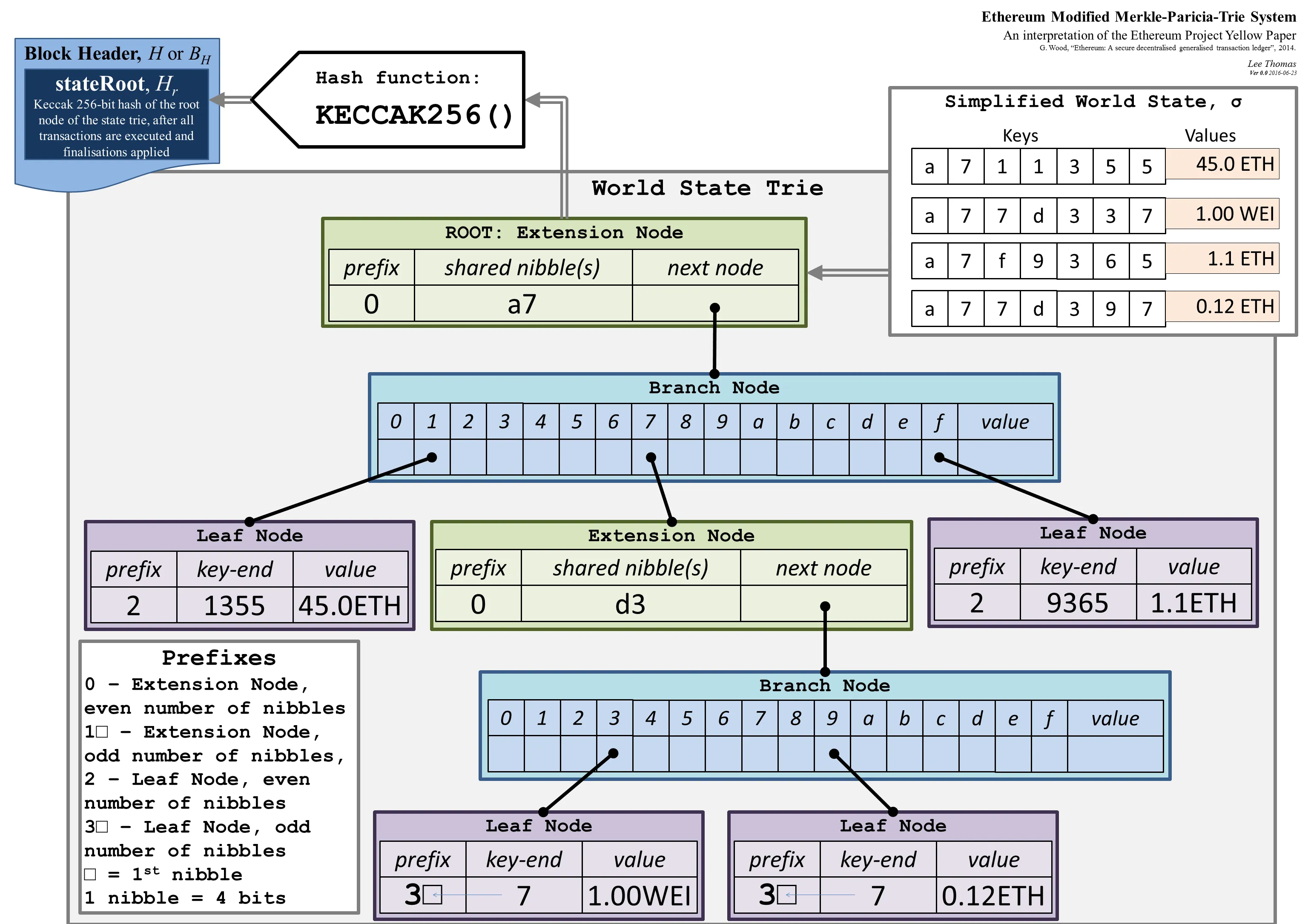
Section titled “Part 3: Ethereum’s Merkle Patricia Trie (MPT)”Ethereum uses a Modified Merkle Patricia Trie (MPT) for authenticated key-value data, instead of a simple binary Merkle tree.
What it stores at a high level:
- State trie: maps each account address to account data (nonce, balance, code hash, storage root).
- Storage trie (one per contract account): maps storage slot keys to storage values.
- Transactions trie (per block): maps transaction index to transaction data.
- Receipts trie (per block): maps transaction index to receipt data.
Why this structure is authenticated:
- Trie paths make key-based lookup and update deterministic.
- Every node is encoded and hashed.
- The top hash (root) is committed in the block header.
- Any change to a covered key/value changes hashes up the path and therefore changes the root.
Minimal node/path concepts (enough to reason about proofs):
- Branch node: up to 16 child pointers (one for each hex nibble) plus an optional value.
- Extension node: compresses a shared path segment when there is no branch decision yet.
- Leaf node: ends a path and stores the final value.
- Nibble path: keys are traversed as hex half-bytes (
0tof), one nibble per step.
This “Patricia” path compression is why extension/leaf nodes exist: long single-child chains are compacted.
At a high level, Ethereum commits these tries in execution-layer block headers via:
stateRoottransactionsRootreceiptsRoot
Source: ELI5 How does a Merkle-Patricia-trie tree work
Part 4: The Three Header Roots in EL Context
Section titled “Part 4: The Three Header Roots in EL Context”1. State Root (stateRoot)
Section titled “1. State Root (stateRoot)”Commits the full post-block world state through the global state trie.
Practical meaning: if two nodes execute the same block correctly, they should derive the same stateRoot.
2. Transactions Root (transactionsRoot)
Section titled “2. Transactions Root (transactionsRoot)”Commits the block’s ordered transactions through the per-block transactions trie.
Practical meaning: transaction inclusion and order are both covered by the commitment.
3. Receipts Root (receiptsRoot)
Section titled “3. Receipts Root (receiptsRoot)”Commits receipts through the per-block receipts trie (status, cumulative gas used, logs bloom, logs, and related fields).
Practical meaning: execution outcomes and emitted logs are committed, not just raw transactions.
Execution-layer validation checks that roots recomputed from block data and state transitions match the roots claimed in the block header.
Part 5: Proofs and Verification Intuition
Section titled “Part 5: Proofs and Verification Intuition”A Merkle-Patricia proof is a set of trie nodes that lets a verifier check a claim against a trusted header root.
Typical claim examples:
- “This account had this value under
stateRoot.” - “This storage slot had this value under
stateRoot.” - “This transaction or receipt is included under this block root.”
Verification intuition:
- Start from the query key (address, storage slot key, or tx index key).
- Walk the nibble path using the provided nodes (branch/extension/leaf transitions).
- Re-encode and hash each visited node.
- Confirm child references and path segments are consistent.
- Confirm the final reconstructed top hash equals the trusted root from the block header.
- Confirm the terminal value matches the claimed value (or confirms non-inclusion, when applicable).
Why this works:
- The verifier does not need the full database.
- Any tampering with node content, path, or value changes hashes and breaks the root match.
- Trust is anchored in the block header root, not in the proof provider.
Part 6: Performance and Design Tradeoffs
Section titled “Part 6: Performance and Design Tradeoffs”MPT strengths:
- Strong commitment security model.
- Deterministic, consensus-safe encoding and hashing.
- Supports authenticated key-value queries.
MPT pain points:
- Larger proof sizes than newer commitment schemes.
- Expensive witness sizes for stateless validation goals.
- Database complexity under frequent state updates.
Part 7: Verkle Trees (Roadmap Direction)
Section titled “Part 7: Verkle Trees (Roadmap Direction)”Verkle trees are proposed as a future commitment structure to reduce proof sizes and improve stateless-client feasibility.
High-level motivation:
- Smaller witnesses for state proofs.
- Better scalability for proof-heavy workflows.
- Improved path toward more efficient stateless verification.
Important status note:
- Verkle migration is a roadmap effort and depends on protocol-fork rollout.
- Always check current mainnet fork status before assuming production deployment.
Part 8: Practical Reading Path
Section titled “Part 8: Practical Reading Path”- Start with Merkle tree basics: hash chaining and root commitments.
- Learn MPT as an authenticated map: key lookup plus tamper-evident root.
- Understand the three MPT node roles: branch, extension, leaf.
- Understand nibble-path traversal and why path compression exists.
- Connect each execution-layer header root to its corresponding trie and proof type.
- Then study Verkle trees as a roadmap direction for smaller proofs and better stateless-client ergonomics.
Part 9: References
Section titled “Part 9: References”Merkle tree
Section titled “Merkle tree”- Merkle tree in Bitcoin - BitcoinWiki
- Merkle Tree with real world examples - YouTube
- What is the merkle tree in Bitcoin? - YouTube
- How Merkle Trees Enable the Decentralized Web! - YouTube
Merkle Patricia Trie
Section titled “Merkle Patricia Trie”- Merkle Patricia Trie | ethereum.org
- What are Patricia Merkle Tries? | Alchemy Docs
- ELI5: How does a Merkle Patricia Trie tree work? | Ethereum Stack Exchange
- Ethereum Merkle Patricia Tree overview (Zhihu)