Transaction Flow
Ethereum Transaction types
Section titled “Ethereum Transaction types”| Type Identifier | Name | Pros |
|---|---|---|
| Legacy (pre-2718) | Untyped RLP transactions | Often shown as type: 0x0 in RPC responses. |
0x01 | EIP-2930 transactions | Access lists can reduce first-touch gas uncertainty. |
0x02 | EIP-1559 transactions | Predictable fees with base fee plus adjustable tip. |
0x03 | EIP-4844 transactions | Much cheaper blob data for rollup data availability. |
0x04 | EIP-7702 transactions | Adds delegation-based execution capability to EOAs under EIP-7702 rules. |
Ethereum Transaction
Section titled “Ethereum Transaction”- Ethereum block = header + body.
- Header stores commitment and metadata fields.
- Transactions are in the body; header references them via transactionsRoot and receiptsRoot.
Part 1: Block Header Fields
Section titled “Part 1: Block Header Fields”Here is the Ethereum Block Header data structured into a clean Markdown table, matching the format you provided for the transaction fields:
| Header Field | Meaning | Why It Matters |
|---|---|---|
| stateRoot | Keccak-256 hash of the global state trie’s root node. | Mathematically anchors and verifies all account balances, nonces, and smart contract storage. |
| transactionsRoot | Keccak-256 hash of the root node of the block’s transaction trie. | Cryptographically proves exactly which transactions were included in the block. |
| receiptsRoot | Keccak-256 hash of the root node of the block’s transaction receipts trie. | Proves the execution outcomes (success/failure, logs, gas used) of the block’s transactions. |
| withdrawalsRoot | Keccak-256 hash of the root node of the validator withdrawals trie. | Tracks staked ETH securely returning from the Consensus Layer (Beacon Chain) to the Execution Layer. |
| parentHash | Keccak-256 hash of the previous block’s entire header. | Cryptographically links this block to the previous one, forming the immutable “blockchain”. |
| number | Scalar value representing the ancestor block count (block height). | Defines the exact sequence and length of the blockchain. |
| timestamp | Unix time of the block’s inception. | Provides a chronological anchor for the block and allows smart contracts to use time-based logic. |
| gasLimit | Maximum allowed computational work (gas) for the block. | Caps block size and execution time to prevent network overload. |
| gasUsed | Total computational work (gas) actually consumed by all transactions in the block. | Measures the block’s actual fullness and execution footprint. |
| baseFeePerGas | Amount of ETH (in wei) burned per unit of gas consumed (EIP-1559). | Manages network congestion and makes gas prices predictable while burning ETH supply. |
| beneficiary | The 160-bit address of the fee recipient. | Determines who receives the unburned priority fees (tips) as a reward for proposing the block. |
| logsBloom | A space-efficient Bloom filter composed of logger addresses and topics. | Allows light clients to rapidly search for specific smart contract events/logs without downloading full data. |
| prevRandao | The latest RANDAO mix from the Consensus Layer. | Provides a secure source of on-chain randomness for smart contracts to utilize. |
| extraData | A 32-byte (or fewer) array for arbitrary data. | Allows block proposers/validators to leave custom messages, tags, or signatures on the block. |
| ommersHash | Fixed to KEC(RLP(())) (hash of an empty list). | Deprecated (Zombie Field). Kept for backward compatibility with pre-Merge Proof of Work logic. |
| difficulty | Fixed to 0. | Deprecated (Zombie Field). Mining difficulty is obsolete under Proof of Stake. |
| nonce | Fixed to 0x0000000000000000. | Deprecated (Zombie Field). Proof of Work mining nonces are no longer used. |
Trie (specifically the Modified Merkle Patricia Trie) is the structure used to commit three roots in the header (stateRoot, transactionsRoot, receiptsRoot).
For a focused explainer on Merkle trees, MPT, and Verkle-tree roadmap context, see Merkle and Trie Concepts.
Part 2: Core Transaction Body (Developers Docs)
Section titled “Part 2: Core Transaction Body (Developers Docs)”An Ethereum transaction is a signed message that requests value transfer or contract execution.
| Tx Field | Meaning | Why It Matters |
|---|---|---|
| nonce | Number of transactions already sent by sender account | Prevents replay and enforces order |
| to | Receiver address (or empty for contract creation) | Defines call/deploy target |
| value | Amount sent in Wei | Transfers ETH with transaction |
| data | Optional calldata payload | Calls functions or carries deployment bytecode |
| gasLimit | Max gas sender allows for this tx | Caps tx execution work |
| gasPrice | Legacy fee per gas unit | Used in legacy tx type |
| maxPriorityFeePerGas | Max tip per gas to validator | Incentivizes faster inclusion |
| maxFeePerGas | Max total fee per gas sender accepts | Caps worst-case fee in EIP-1559 |
| sender + signature | ECDSA signature over tx payload (v,r,s) | Proves authorization and derives sender |

Overview (vanilla block building)
Section titled “Overview (vanilla block building)”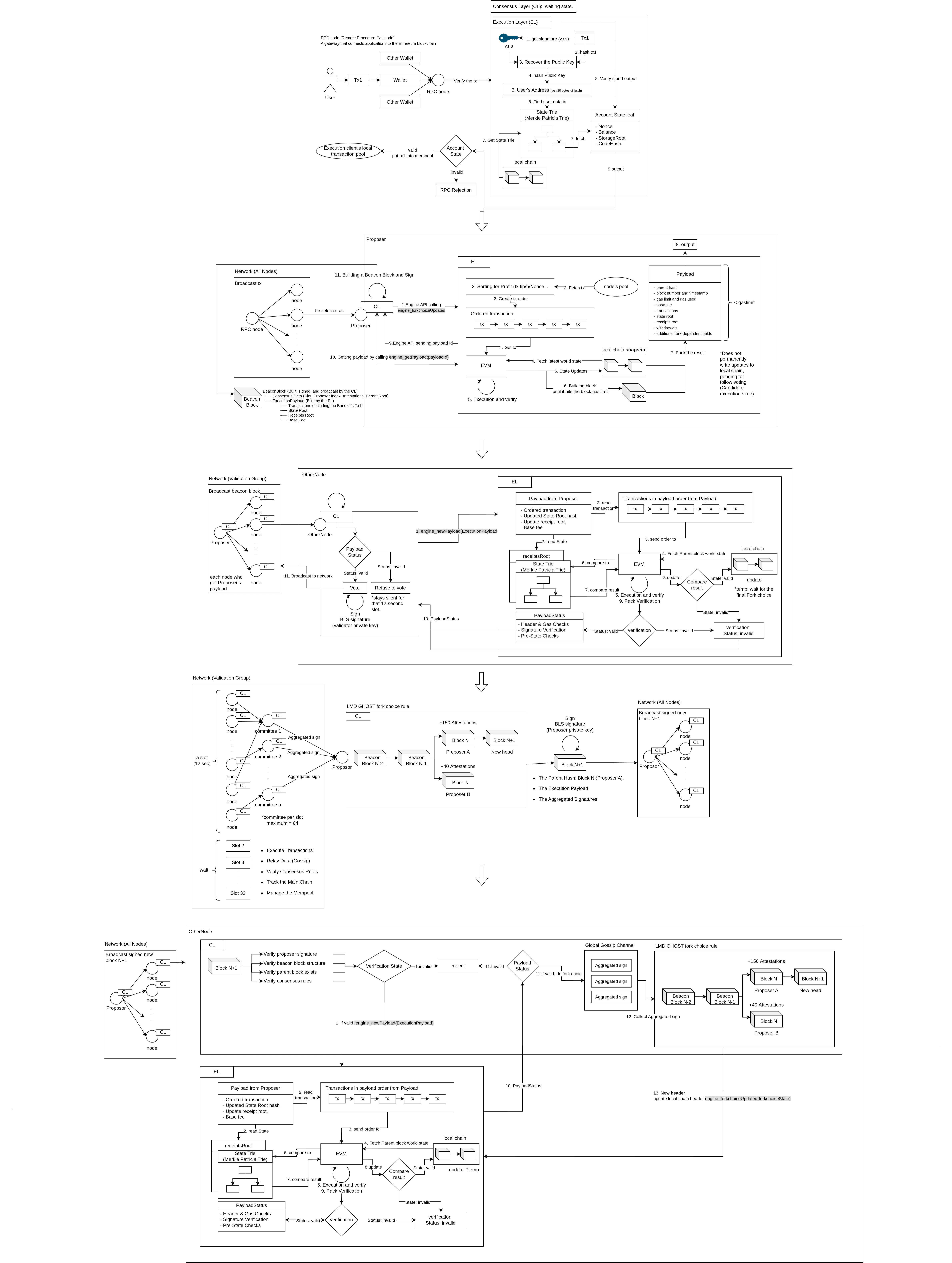
Estimated Transaction number in block
Section titled “Estimated Transaction number in block”The number of transactions selected in a block depends on that block’s gasLimit and the gas profile of included transactions. View live time gas limit: Gas Limit monitor
- Extreme theoretical upper bound (simple ETH transfers only)
If all included transactions are the simplest ETH transfers (no smart-contract execution):
- Gas per transaction: fixed at 21,000 gas.
- Example (if
gasLimit = 30,000,000): 30,000,000 / 21,000 = 1,428.57 - Conclusion for this example: one completely full block can contain about 1,428 transactions.
How Many Transactions Would Be Selected in a Block?
Section titled “How Many Transactions Would Be Selected in a Block?”Use the block gas limit divided by average gas per transaction:
For the pure ETH transfer upper-bound example with GasLimit_block = 30,000,000:
TPS Calculation
Section titled “TPS Calculation”Assuming average block time is about 12 seconds:
For the upper-bound simple-transfer case:
So the theoretical maximum in this simplified scenario is about 119 TPS.
Part 3: Transaction flow types
Section titled “Part 3: Transaction flow types”A transaction is a signed, externally originated request to modify execution-layer state.
flowchart TD
  A[world state sigma_t] -->|"apply block b = (T1, T2, T3)"| B[world state sigma_t+1]
  B -->|"apply block b+1 = (T4, T5, T6)"| C[world state sigma_t+2]
State transition function (conceptual):
Where U is the block transition function and B_t is the ordered payload content processed at height t.
In modern Ethereum, block processing includes both transactions and protocol-level payload fields (for example withdrawals), so the post-state is not a function of transactions alone.
Who Sends What to Whom
Section titled “Who Sends What to Whom”- User/Wallet
- Creates and signs a transaction.
- Sends signed transaction bytes to an RPC node using
eth_sendRawTransaction. - May instead send private orderflow to a searcher/builder endpoint (not protocol-required).
- Node (RPC + txpool, EL client)
- RPC accepts transaction submission.
- EL validates transaction and, if valid, stores it in txpool.
- Gossips transaction to other EL peers (public mempool path).
- Searcher (out-of-protocol)
- Builds bundle/orderflow strategies.
- Sends bundles or private flow to builders/relays.
- Does not propose blocks in Ethereum consensus.
- Builder (out-of-protocol)
- Builds candidate execution payloads from public mempool and/or private flow.
- Sends bids/payload commitments to relays.
- Relay (out-of-protocol)
- Receives builder bids.
- Verifies bid/payload checks per relay policy.
- Forwards bid data to a proposer using MEV-Boost.
- Proposer (validator, in-protocol)
- Is selected by CL for the slot.
- Proposes the beacon block.
- Uses either a local EL-built payload (no MEV-Boost) or a builder-provided payload (MEV-Boost path).
- CL vs EL responsibilities (in-protocol)
- CL: proposer selection, fork choice, attestations, finality, beacon block propagation.
- EL: transaction validation, txpool, EVM execution, state transition, payload validity via Engine API.
Canonical Flow A: Public Mempool Path (Baseline)
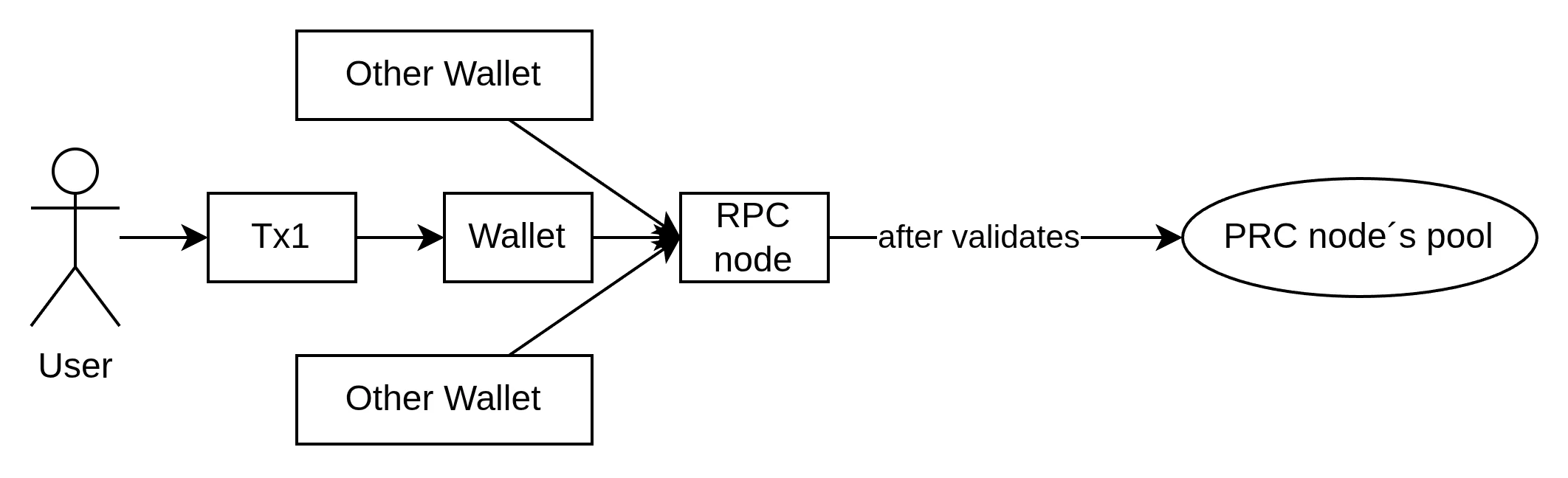
Section titled “Canonical Flow A: Public Mempool Path (Baseline)”- User signs tx in wallet.
- Wallet sends signed tx to RPC node via
eth_sendRawTransaction. - EL validates tx and admits it to local txpool if accepted.
- EL gossips tx across EL P2P; peers repeat validation/admission.
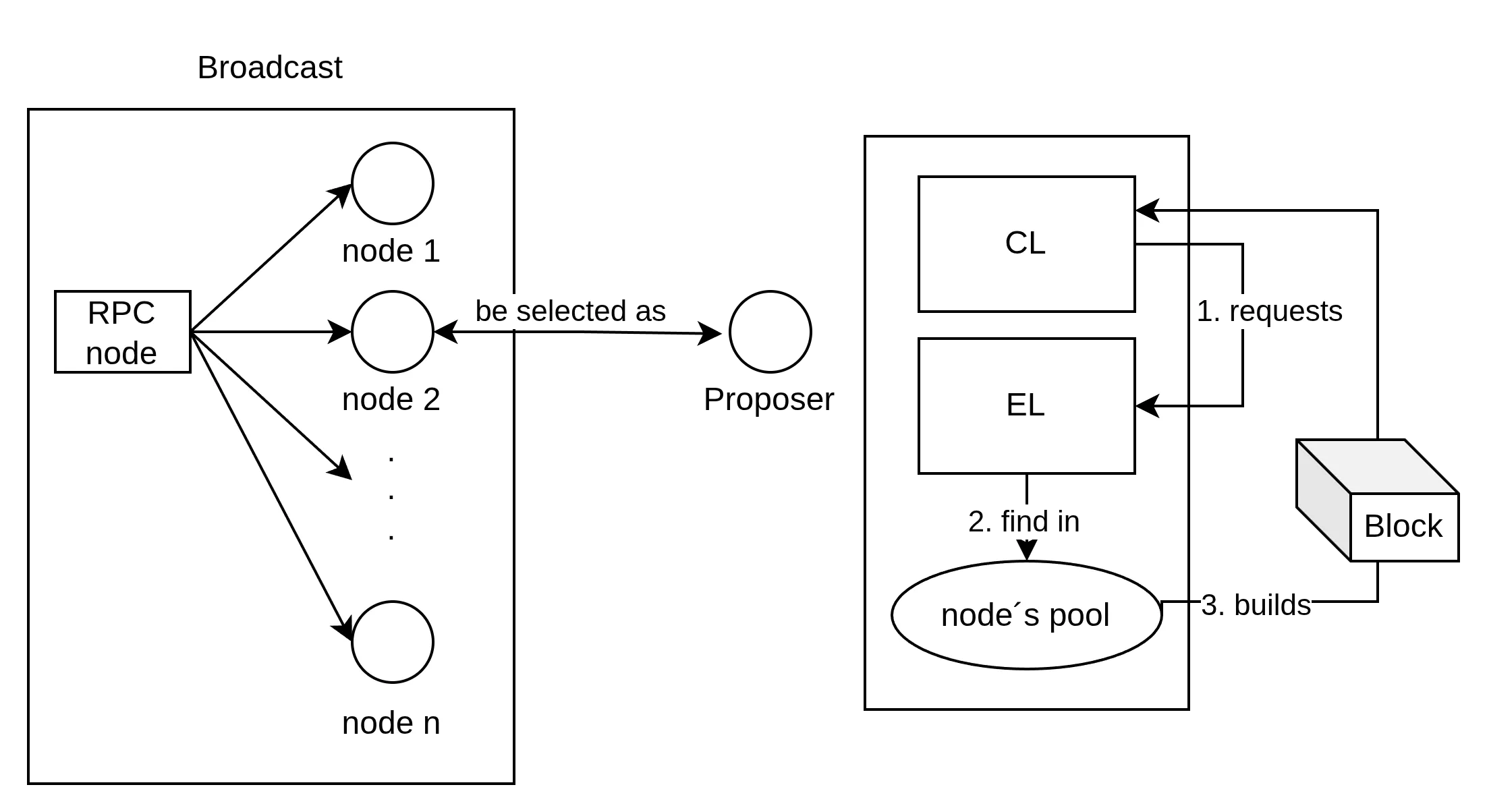
- At slot time, CL-selected proposer requests an execution payload from its EL.
- Proposer’s EL builds payload from available txpool transactions.
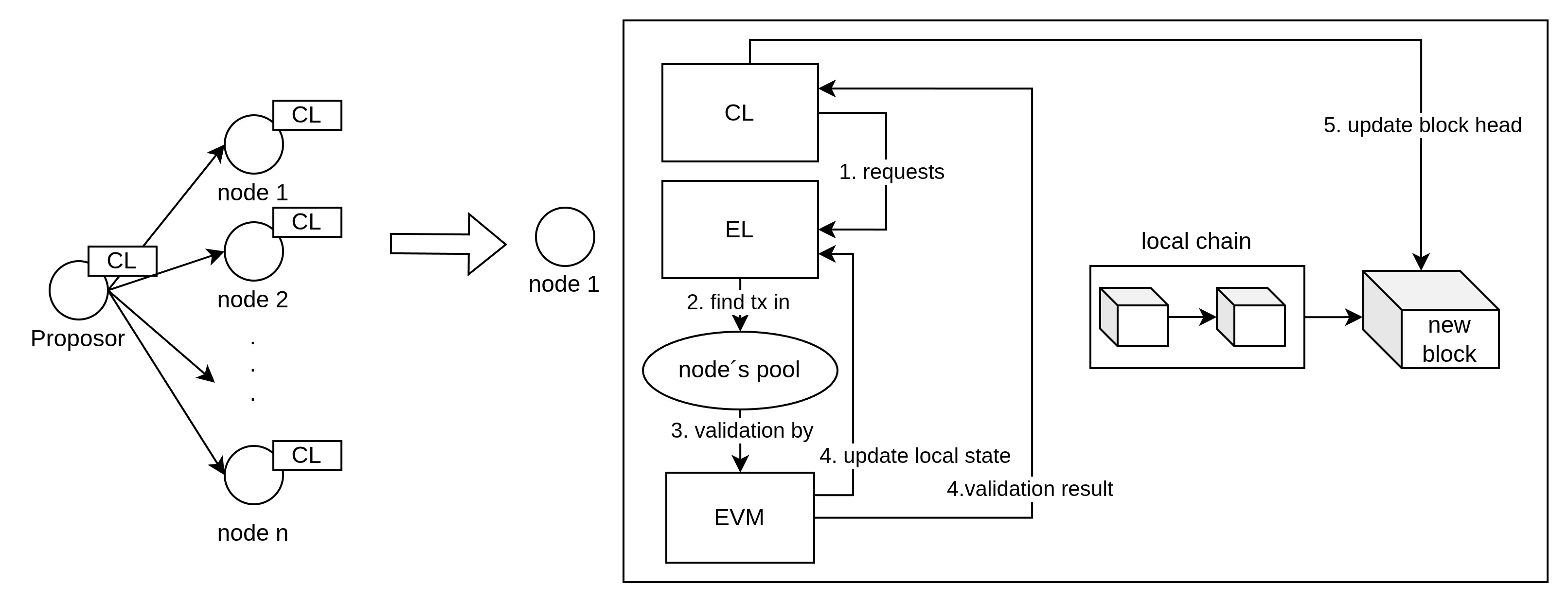
- Proposer publishes beacon block (with execution payload) on CL network.
- Other nodes validate with CL consensus checks + EL re-execution checks.
Canonical Flow B: Private Orderflow / Searcher-Builder Path (MEV-Boost)
Section titled “Canonical Flow B: Private Orderflow / Searcher-Builder Path (MEV-Boost)”- User/searcher sends private orderflow or bundles to builder channels.
- Builders construct candidate payloads and attach bids.
- Builders submit bids to relays.
- Relays expose blinded bids to the slot proposer running MEV-Boost.
- Proposer selects a valid bid and signs the blinded path.
- Relay releases the full payload for the winning bid.
- Proposer publishes the beacon block through CL.
- Network validation remains in-protocol (CL + EL checks).
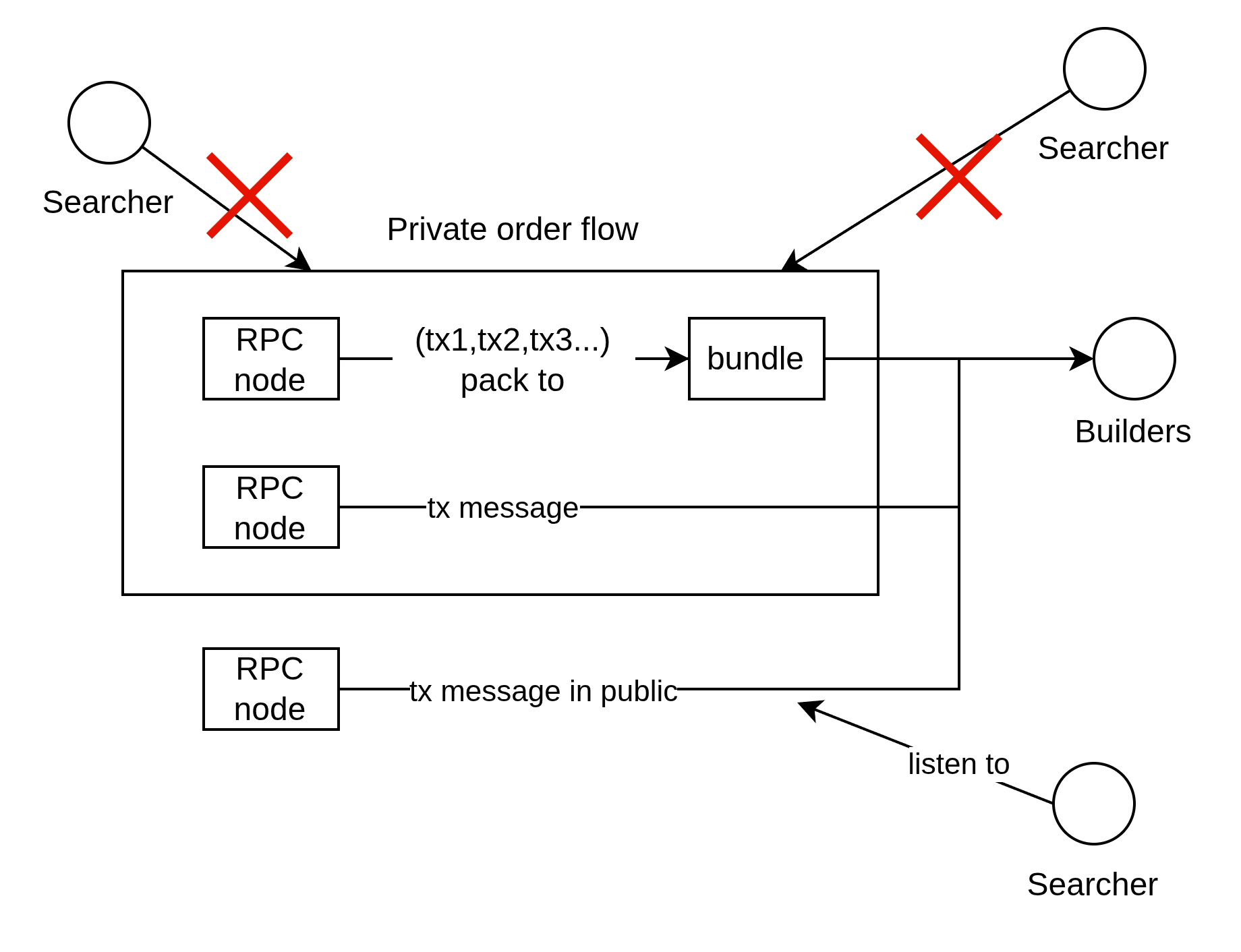
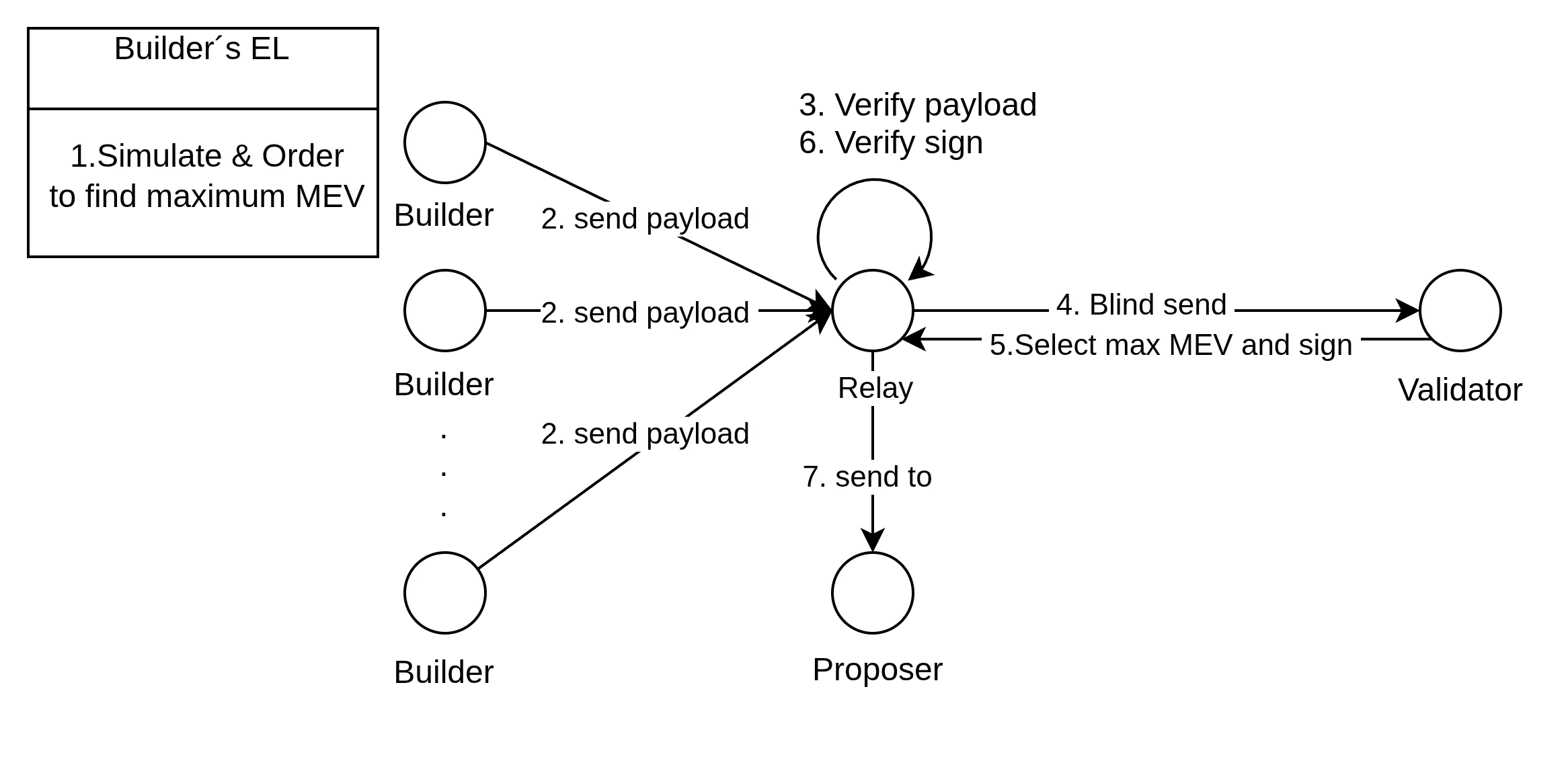
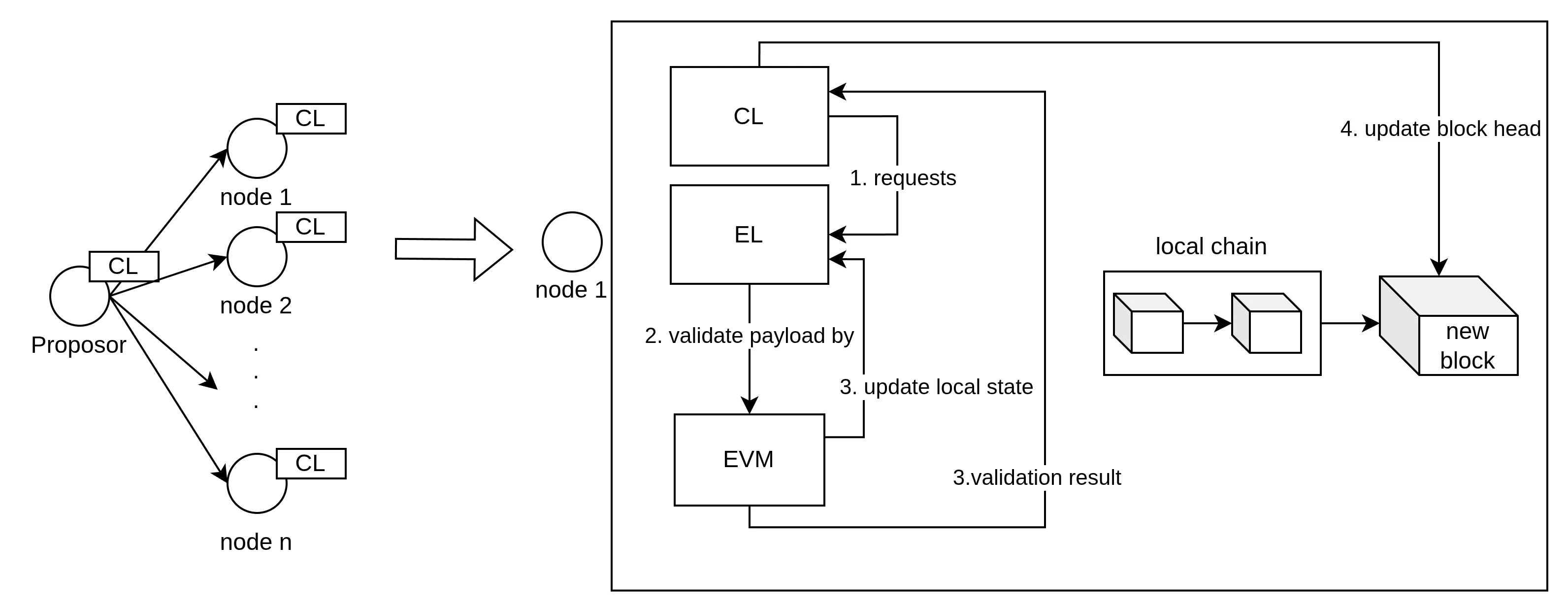
Important: builder/relay/MEV-Boost are out-of-protocol market infrastructure; Ethereum consensus/finality rules remain in CL + EL protocol clients.
Canonical Flow C: Meta Transactions (Gasless)
Section titled “Canonical Flow C: Meta Transactions (Gasless)”A Meta Transaction is a pattern where the person who creates and signs the transaction is different from the entity that pays the gas to submit it to the blockchain.
The Problem It Solves
Section titled “The Problem It Solves”Normally, every Ethereum interaction requires the sender to hold ETH for gas. This is a significant onboarding hurdle. Meta transactions allow users to interact with dApps without needing to hold any ETH.
The Technical Flow (ERC-2771)
Section titled “The Technical Flow (ERC-2771)”- Off-chain Signature: The user signs a message (e.g., “transfer 10 tokens”) using their private key. This costs zero gas as it happens off-chain.
- The Relayer: The user sends this signed message to a Relayer (a third-party service).
- The Broadcast: The Relayer wraps the signed message in a standard Ethereum transaction, pays the gas fee, and broadcasts it.
- Forwarder Verification: A Forwarder contract (Standardized by ERC-2771) verifies the user’s signature.
- Execution: If valid, the Forwarder calls the target smart contract. The target contract uses
_msgSender()to identify the original signer instead ofmsg.sender(which would be the Relayer).
ERC-2771 is the industry standard that allows smart contracts to “look past” the Relayer/Forwarder and correctly identify the actual user who authorized the action.
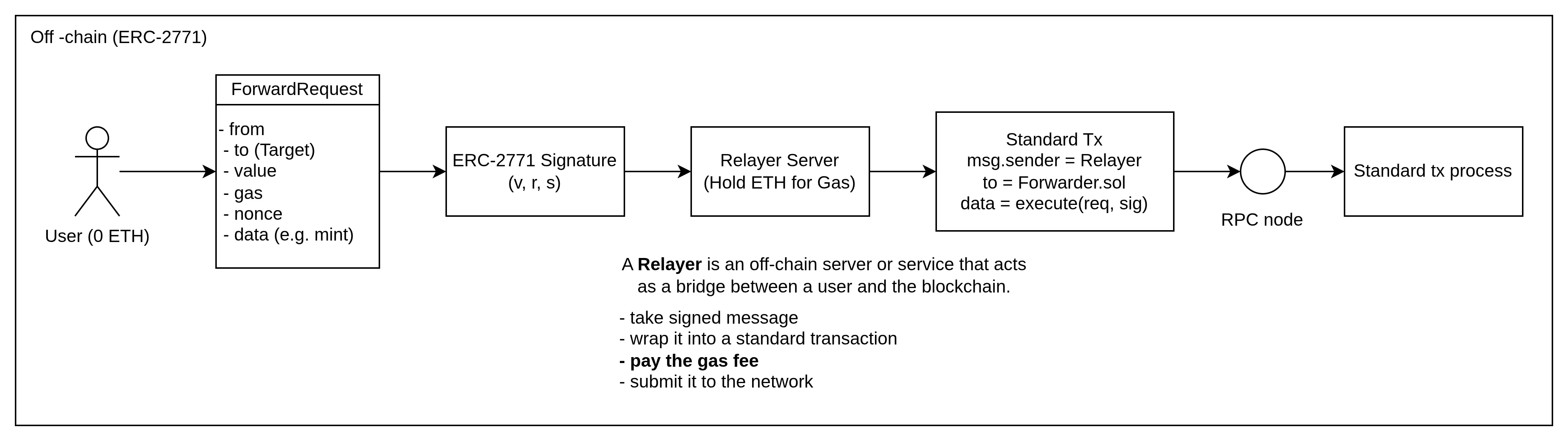
The Relayer pays the ETH gas fees on-chain to the network. In return, the user can reimburse the Relayer using any ERC-20 token (such as USDC or USDT) either off-chain or via the smart contract. Alternatively, the dApp developers can fully subsidize the cost, providing a completely gasless experience for the user.
Canonical Flow D: Account Abstraction (ERC-4337)
Section titled “Canonical Flow D: Account Abstraction (ERC-4337)”Account Abstraction (AA) is a paradigm shift that decouples the relationship between an account’s signer (the key) and its balance (the ETH), allowing any smart contract to act as a wallet.
The UserOperation structure
Section titled “The UserOperation structure”| Field | Type | Description |
|---|---|---|
sender | address | The Account making the UserOperation |
nonce | uint256 | Anti-replay parameter (see “Semi-abstracted Nonce Support” ) |
factory | address | Account Factory for new Accounts OR 0x7702 flag for EIP-7702 Accounts, otherwise address(0) |
factoryData | bytes | data for the Account Factory if factory is provided OR EIP-7702 initialization data, or empty array |
callData | bytes | The data to pass to the sender during the main execution call |
callGasLimit | uint256 | The amount of gas to allocate the main execution call |
verificationGasLimit | uint256 | The amount of gas to allocate for the verification step |
preVerificationGas | uint256 | Extra gas to pay the bundler |
maxFeePerGas | uint256 | Maximum fee per gas (similar to EIP-1559 max_fee_per_gas) |
maxPriorityFeePerGas | uint256 | Maximum priority fee per gas (similar to EIP-1559 max_priority_fee_per_gas) |
paymaster | address | Address of paymaster contract, (or empty, if the sender pays for gas by itself) |
paymasterVerificationGasLimit | uint256 | The amount of gas to allocate for the paymaster validation code (only if paymaster exists) |
paymasterPostOpGasLimit | uint256 | The amount of gas to allocate for the paymaster post-operation code (only if paymaster exists) |
paymasterData | bytes | Data for paymaster (only if paymaster exists) |
signature | bytes | Data passed into the sender to verify authorization |
EntryPoint interface
Section titled “EntryPoint interface”When passed on-chain, to the EntryPoint contract, the Account and the Paymaster, a “packed” version of the above structure called PackedUserOperation is used:
| Field | Type | Description |
|---|---|---|
sender | address | |
nonce | uint256 | |
initCode | bytes | concatenation of factory address and factoryData (or empty), or EIP-7702 data |
callData | bytes | |
accountGasLimits | bytes32 | concatenation of verificationGasLimit (16 bytes) and callGasLimit (16 bytes) |
preVerificationGas | uint256 | |
gasFees | bytes32 | concatenation of maxPriorityFeePerGas (16 bytes) and maxFeePerGas (16 bytes) |
paymasterAndData | bytes | concatenation of paymaster fields (or empty) |
signature | bytes |
For more information, please reference EIP4337
ERC-4337 End-to-End Workflow
Section titled “ERC-4337 End-to-End Workflow”Here is the complete ERC-4337 End-to-End Workflow with the concepts of function routing, arbitrary calldata, and security seamlessly integrated into Phase 3:
Phase 1: Off-Chain Intent and Bundling
Section titled “Phase 1: Off-Chain Intent and Bundling”- Create and Sign: The user creates and signs a UserOperation (UserOp) through a wallet or dApp. The UserOp describes the requested action, such as transferring 50 USDC. Signing occurs off-chain; the user does not need ETH if a Paymaster sponsors the gas.
- UserOp Mempool: The UserOp is sent to a Bundler and may be propagated through an ERC-4337 UserOperation mempool.
- Validation and Bundling: The Bundler simulates and validates the UserOp. It then packages one or more valid UserOps into a standard Ethereum transaction calling:
EntryPoint.handleOps(userOps, beneficiary). The Bundler’s EOA initially pays the outer transaction gas.
Phase 2: Standard On-Chain Processing
Section titled “Phase 2: Standard On-Chain Processing”- Block Inclusion: Ethereum processes the Bundler’s transaction like a normal EOA-to-contract transaction. The network checks the Bundler EOA’s signature, balance, and transaction nonce before including it in a block.
Phase 3: ERC-4337 Execution in the EVM
Section titled “Phase 3: ERC-4337 Execution in the EVM”-
EntryPoint Invocation: The EVM executes the Bundler transaction and calls the global EntryPoint contract’s
handleOps()function. -
Validation and Prefund: For each UserOp, EntryPoint:
-
Deploys the Smart Account through its Factory if necessary. ERC-4337 Contract Example
-
Validates the ERC-4337 nonce.
-
Calls the Smart Account’s
validateUserOp()to verify authorization, such as an owner key, passkey, or multisig. -
If specified, calls the Paymaster to confirm sponsorship.
-
Confirms that the Smart Account or Paymaster has sufficient ETH deposited in EntryPoint.
-
Execution & Function Routing: After successful validation, EntryPoint calls the Smart Account with the UserOp’s
callData. -
Arbitrary Execution: The network treats the
callDatafield as an opaque, uninterpreted byte stream. EntryPoint does not inspect or understand the target function; it simply forwards this raw byte payload to the Smart Account via an externalCALL. -
Architectural Freedom: There are no hardcoded execution standards at the protocol level. While functions like
executeorexecuteBatchare industry conventions, the Smart Account can define custom interfaces, perform self-administrative tasks (e.g., swapping a recovery module), or run atomic actions immediately alongside its deployment. -
Critical Security Guard: Because routing is completely open-ended, the Smart Account must govern its own security. All execution functions must include an explicit modifier checking that
msg.sender == ENTRY_POINT. Without this restriction, attackers could bypass the network infrastructure and call the execution functions directly to drain assets. -
Settlement: EntryPoint calculates the actual UserOp cost and charges the Smart Account’s or Paymaster’s ETH deposit. After processing the bundle, EntryPoint transfers the collected compensation to the specified beneficiary, which is usually controlled by the Bundler.
Core Roles and Details Comparison
Section titled “Core Roles and Details Comparison”| Role | Core Responsibility | Key Nuances & Nonce Handling |
|---|---|---|
| User | Signs “UserOp” intent to authorize actions. | No EOA Nonce. User doesn’t need to hold ETH or manage a seed phrase; can use biometrics (FaceID/TouchID) or social recovery. |
| SCW (Smart Contract Wallet) | Verifies user signatures and executes final logic. | 2D Nonce (Two-Dimensional): Uses a custom Nonce mechanism independent of the base layer, allowing for parallel (non-blocking) transaction processing. |
| Bundler | Simulates UserOps, bundles them, and pays upfront Gas. | Standard EOA Nonce. Acts as a traditional EOA. Uses a standard incrementing Nonce. Takes the risk of failed Gas if execution fails on-chain. |
| EntryPoint | Global coordinator, security gate, and settlement hub. | Stateless Singleton. The ultimate trust anchor in the AA architecture. Ensures Bundlers are repaid and enforces the order of verification and execution. |
| Paymaster | Sponsors Gas fees based on custom logic. | Deposit-based. Enables “Gasless” UX or paying gas with ERC-20 tokens. Must pre-fund or stake ETH in the EntryPoint as collateral. |
| Proposer / RPC Node | Validates and includes the standard transaction bundles. | AA-Agnostic. Only checks the Bundler’s signature, base-layer Nonce, and balance. It sees it as a simple call to the EntryPoint bytecode. |
Part 4: Transaction process
Section titled “Part 4: Transaction process”Transaction Creation and Propagation
Section titled “Transaction Creation and Propagation”- Creation: EOAs (or account-abstraction style user flows that still resolve to valid EL transaction envelopes) create a transaction with nonce, fee settings, recipient, value, and optional calldata, then sign it cryptographically.
- Broadcast: The signed transaction is sent to the peer-to-peer network, where nodes place it in their mempool (unconfirmed transaction pool).
- Propagation: Nodes relay valid transactions to peers after basic checks (field validity and signature verification). Mempool policies such as fee prioritization and eviction affect relay and retention.
Transmitting Value to EOAs and Contracts
Section titled “Transmitting Value to EOAs and Contracts”Ethereum value transfers are processed based on the recipient type: transfers to EOAs only update balances, while transfers/calls to contracts can trigger code execution depending on calldata and whether receive()/fallback() is defined.
If a contract has no code path to move ETH out (for example, no callable withdrawal logic), ETH sent to it may become permanently inaccessible.
Transaction steps
Section titled “Transaction steps”Detail flow with original code
1. Entry Point
Section titled “1. Entry Point”When you submit a transaction, the path depends on how it is signed:
-
Node-signed: If you let the node sign the transaction, it enters through
eth_sendTransaction.Use
eth_sendRawTransactionwhen your app/user controls keys and you want the node to be broadcast-only. -
Pre-signed: If you have already signed the transaction yourself, it enters through
eth_sendRawTransaction.eth_sendTransactionis often disabled on public RPC providers because it requires server-side key management. -
Both of these paths eventually converge in the client submission path, which forwards the transaction into local validation and txpool admission.
[Node-Signed (eth_sendTransaction)]Your app (unsigned tx data) -> Node (private key is managed here) -> [Node signs transaction] -> Broadcast to Ethereum network
[Pre-Signed (eth_sendRawTransaction)]Your app or wallet (private key is managed here) -> [Local signing] -> Node (receives signed raw transaction bytes only) -> Broadcast to Ethereum network
2. Pre-checks (Validation)
Section titled “2. Pre-checks (Validation)”Before entering the pool, the transaction undergoes multiple layers of checks:
- RPC Layer: Applies node/provider policy checks (for example configured fee caps), while protocol-validity checks (signature, chain-domain/replay protection, type/fork validity) are enforced in tx decoding/validation paths.
- Txpool Stateless Validation: Checks if the signature and sender are correct, if there is sufficient gas, if the transaction type matches current fork rules, and if structures like blobs or set-code authorizations are valid.
- Txpool Stateful Validation: Verifies if the nonce is too high or too low, if the account balance is sufficient, and if it complies with the pool’s gap and slot rules.
3. Entering a Node’s Txpool
Section titled “3. Entering a Node’s Txpool”Once the transaction passes validation, it is added to the transaction pool:
- Queued/Future: If there is a nonce gap (for example, a missing prior nonce), many clients keep the tx in a non-executable subpool.
- Pending/Executable: If the transaction can execute against current account nonce/balance constraints, it stays in an executable subpool.
Exact subpool names and promotion/eviction policies are client-specific (for example, Geth/Erigon/Nethermind differ).
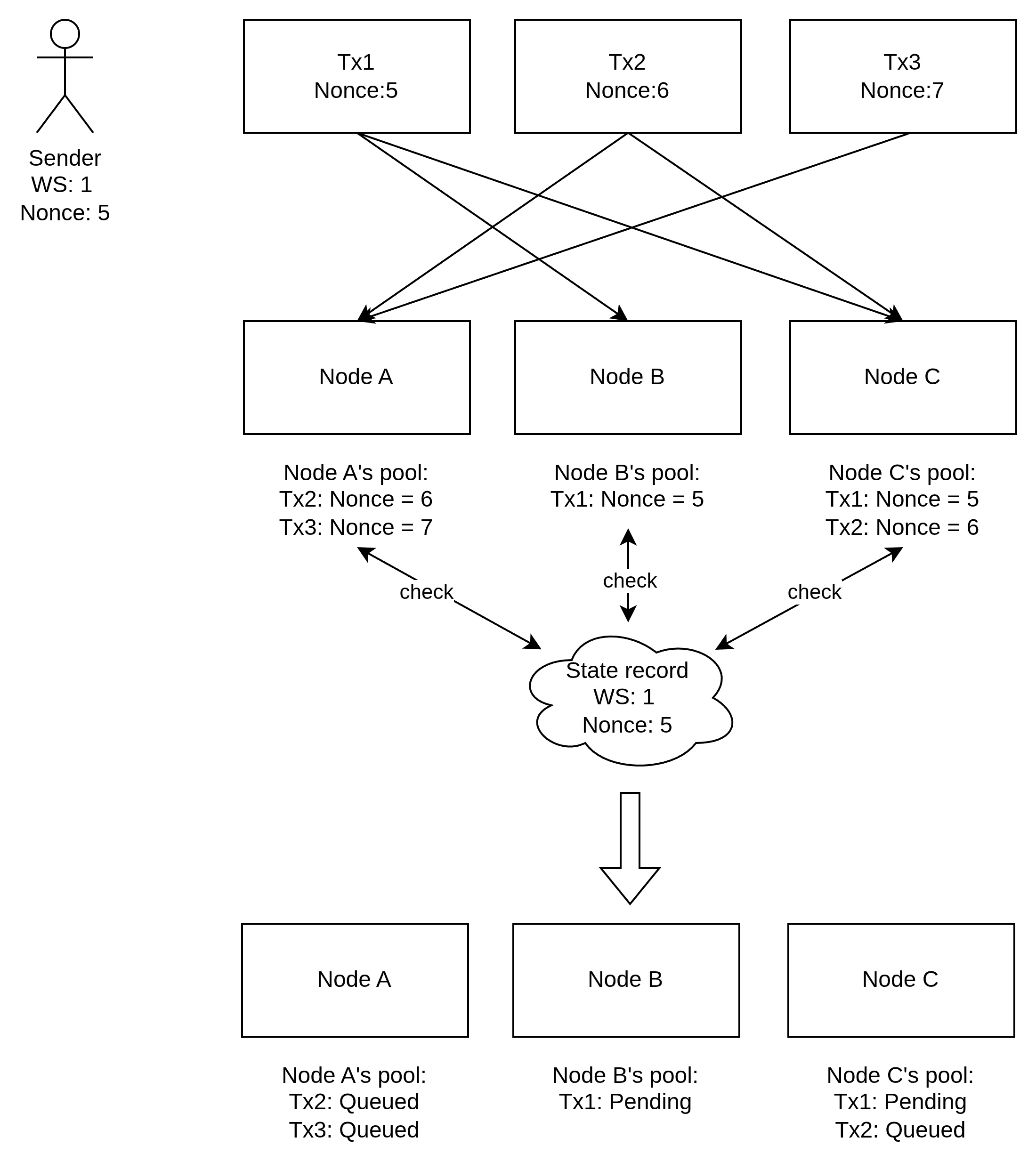
WS = World State, Tx = Transaction.
| Nonce Function | Practical Effect |
|---|---|
| Prevent replay attacks | Makes each transaction unique, preventing copy-and-resend attacks. |
| Enforce transaction order | Forces transactions from the same account to execute in sequence. |
| Replace stuck transactions | Lets you resubmit the same nonce with a higher fee to speed up or replace a pending tx. |
| Track account history | Acts as a running counter of confirmed outgoing transactions for the account. |
4. Broadcasting to Peers
Section titled “4. Broadcasting to Peers”The node shares the new transaction with the rest of the network:
- It broadcasts the transaction using an internal event system.
- Depending on protocol path and peer state, propagation may use announcements first (hashes/IDs) with bodies requested on demand.
- Propagation rules for blob transactions are strictly tighter than those for standard transactions.
5. Inclusion in a Block (Block Building)
Section titled “5. Inclusion in a Block (Block Building)”In post-Merge Ethereum, block construction is commonly separated from block proposal through out-of-protocol Proposer-Builder Separation (PBS) infrastructure such as MEV-Boost.
MEV-Boost Role Format
Section titled “MEV-Boost Role Format”- Users and Searchers: Users submit normal transactions (for example, raw transactions), while searchers submit bundles and orderflow designed for MEV strategies.
- Builders: Builders aggregate public mempool flow, private orderflow, and bundles, then construct candidate execution payloads and calculate bid value.
- Relays: Relays verify builder payload validity, publish blinded bids/headers, and route the winning payload path to the selected proposer.
- Validator (Proposer): The proposer requests headers, selects the highest-value valid bid, signs the selected header path, and proposes the corresponding beacon block through the Consensus Layer.
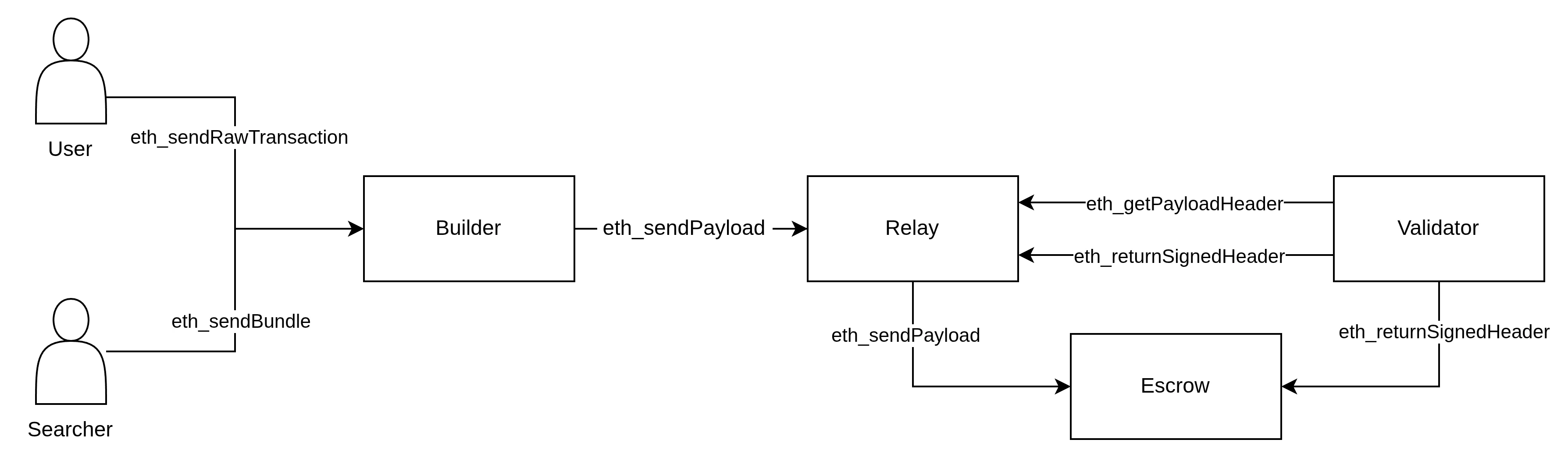
Role Onboarding (Registration vs Integration)
Section titled “Role Onboarding (Registration vs Integration)”| Role | Protocol Registration Required | How to Start | Key Requirements |
|---|---|---|---|
| User | No | Use a wallet and submit transactions to RPC endpoints | Wallet, ETH for gas |
| Searcher | No | Run search/strategy bots and submit bundles or orderflow to builders/relays | MEV strategy logic, low-latency infra |
| Builder | No | Run builder stack, ingest mempool and private flow, construct and bid payloads via relays | Builder software, simulation engine, networking |
| Relay Operator | No | Operate relay service that validates builder payloads and serves blinded bids to proposers | High availability infra, validation and routing logic |
| Validator (Proposer) | Yes | Run consensus and execution clients and activate validator via Ethereum deposit flow | 32 ETH stake per validator, CL+EL operation |
MEV-Boost Flow
Section titled “MEV-Boost Flow”- Users and searchers send transactions or bundles to builders (directly or through orderflow channels).
- Builders construct execution payloads and submit them to relays.
- Relays validate payloads and expose bid headers to the slot proposer.
- The proposer selects a winning header/bid and signs the proposal path.
- The full payload corresponding to the winning bid is released for proposal and execution.
- The Consensus Layer proposes/gossips the block, and the local Execution Layer validates and executes the payload via Engine API.
Common Misconceptions (Quick Corrections)
Section titled “Common Misconceptions (Quick Corrections)”- “Users send transactions directly to proposers.”
- Usually false: users send to RPC nodes or private orderflow endpoints.
- “Builder and proposer are the same protocol role.”
- No: proposer is in-protocol; builder is out-of-protocol infrastructure.
- “Relays are part of Ethereum consensus protocol.”
- No: relays are optional third-party infrastructure for MEV-Boost.
- “CL validates transactions.”
- EL validates/executes transactions; CL handles fork choice and finality.
- “RPC acceptance guarantees inclusion.”
- No: inclusion still depends on fee competitiveness, nonce ordering, and block space.
Block Building Step
Section titled “Block Building Step”- Fork-choice head selection (CL): Before the auction, the proposer’s CL determines the current canonical parent block for this slot. Detail for PoS proposer selection
- MEV-Boost auction: Builders construct payloads on top of that parent and submit bids through relays; the proposer requests and compares relay headers.
- Blind handshake: The proposer signs the selected blinded header, and the relay releases the full execution payload for the winning bid path.
- Block assembly for proposal (CL): The proposer CL assembles the beacon block using the winning execution payload reference/data and proposer signature.
6. EVM Execution
Section titled “6. EVM Execution”The transaction is processed by the Ethereum Virtual Machine (EVM):
- EL payload execution path: EL clients execute/validate payloads through Engine API flows (for example new-payload handling).
- Deterministic transaction execution: The EVM runs transactions in order, applying nonce checks, gas accounting, state transitions, and logs.
- Execution result status: EL returns payload validity (
VALID/INVALID/SYNCING) and related status fields (for examplelatestValidHash) to CL for downstream fork-choice processing.
7. Generating Receipts and Updating State
Section titled “7. Generating Receipts and Updating State”After execution, the results are recorded:
- Receipts include execution status, gas used, emitted logs, and the created contract address when deployment occurs.
- EL computes post-state commitments and receipt commitments (for example
stateRoot,receiptsRoot, and finalgasUsed) from deterministic execution output. - These commitments become the claims that peers later verify during block validation/import.
8. Block Broadcast
Section titled “8. Block Broadcast”After the proposer signs the block, the Consensus Layer (CL) client is responsible for propagating it over the Beacon Chain p2p network:
- The CL client (for example, Prysm or Lighthouse) broadcasts the beacon block (which carries execution payload data/commitments for that fork version) to peers.
- For proposer publication, the local CL gossips beacon blocks, while the local EL receives the selected execution payload via the Engine API.
- EL clients still participate in EL P2P request-response and sync data exchange for execution data.
- This is the end of proposer-side publishing for the slot; network-wide voting and head movement happen after peers receive the block.
- Other peers then run their own CL- and EL-side validation independently.
9. Block Validation and Import
Section titled “9. Block Validation and Import”When the block is received by other nodes (or imported locally), the transactions are verified again:
| Check Category | Validation Logic | Impact if Failure |
|---|---|---|
| Header & Consensus | Validates parent link, timestamp/slot constraints, block size limits, and consensus metadata. | Block rejection (consensus violation). |
| Transaction Integrity | Ensures each transaction encoding/signature is valid and all transaction-root commitments match. | Block rejection (invalid payload). |
| State Transition | Re-runs transactions in order; verifies nonces, account balances, and gas accounting. | Execution failure; block invalidation. |
| Root & Receipts | Confirms computed stateRoot, receiptsRoot, and transactionsRoot match header claims. | State mismatch; block rejection. |
| Gas & Fee Consistency | Verifies gasUsed, EIP-1559 base-fee rules, and per-tx fee accounting are consistent. | Protocol violation; block rejection. |
| Network Attestation | Validators that accept the block attest during slot/epoch voting to signal validity. | Failure to reach finality/canonical status. |
| Fork-Choice Update | CL updates local canonical head as attestations accumulate (with EL coordination). | Node stays on incorrect/old chain fork. |
| Import Decision | Valid blocks become candidates for canonical head; failed blocks are immediately dropped. | Node maintains synchronization with network. |
Part 5. Summary
Section titled “Part 5. Summary”- Ethereum transaction processing is a layered pipeline: submission -> txpool validation -> network propagation -> block inclusion -> EVM execution -> receipt/state commitment -> block broadcast -> block validation/import -> attestation and fork-choice head update.
- A transaction can be accepted by RPC but still be queued (nonce gap), deprioritized (fee conditions), or dropped (pool pressure/policy).
- Block headers commit execution outcomes via
stateRoot,transactionsRoot, andreceiptsRoot, while transaction data lives in the block body. - Consensus safety is enforced at block import by re-validating execution results and commitment consistency before canonical insertion.
- Fork-choice can trigger reorgs; transactions from replaced blocks may return to the pool and compete for inclusion again.